VRF vs Chiller Aircon:
Which is Right for Your Commercial Space?
A complete buyer's guide for Philippine property owners, developers & facilities managers
Choosing the right cooling system for a commercial building in the Philippines is one of the most critical — and expensive — decisions a property owner or facilities manager will make. Get it right, and your building stays comfortable, energy-efficient, and low-maintenance for decades.
Two systems dominate the commercial aircon market: VRF (Variable Refrigerant Flow) and Chiller aircon systems. Both are designed for large-scale cooling — but they work differently, suit different building types, and come with very different cost structures.
In this guide, Mr. Aircon PH breaks down everything you need to know to make the right call for your specific space.
1. What is a VRF Aircon System?
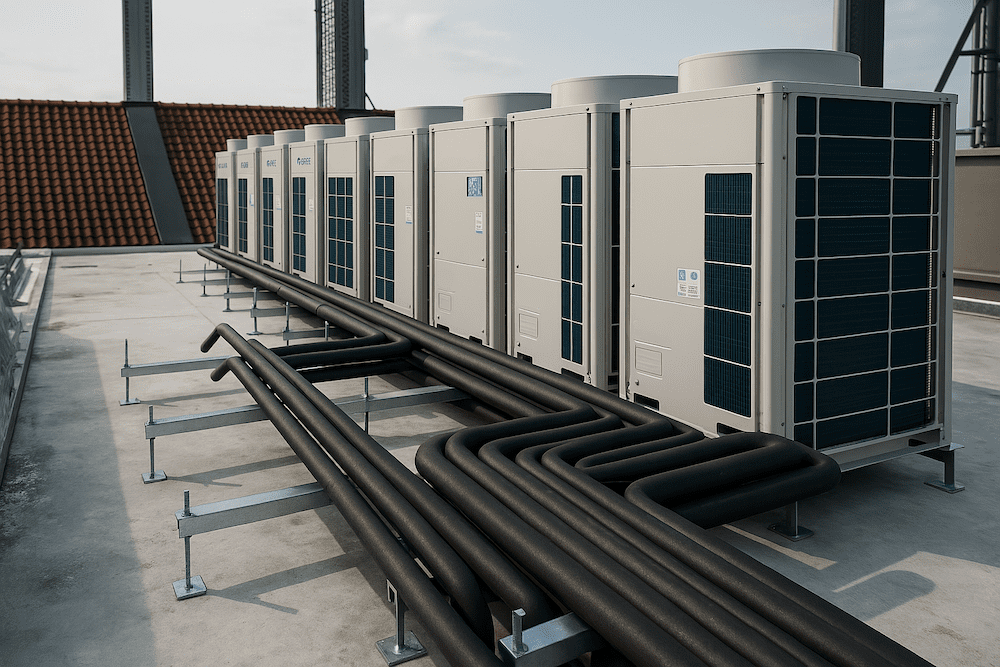
VRF stands for Variable Refrigerant Flow (also called VRV — Variable Refrigerant Volume — Daikin's trademarked term). A VRF system uses refrigerant as the cooling medium, circulating it directly from one large outdoor condenser unit to multiple indoor units spread across an entire building.
The defining feature: VRF varies the amount of refrigerant delivered to each indoor unit independently, based on real-time cooling demand. A packed conference room gets full cooling while an empty office down the hall gets almost none — all simultaneously from the same outdoor unit.
Key Components of a VRF System
- One or more outdoor condenser units (rooftop or ground-level)
- Multiple indoor units: wall mount, ceiling cassette, concealed duct, floor standing
- Refrigerant piping network (pipe runs up to 150–200m possible)
- Central Building Management System (BMS) integration
Where VRF Systems Are Most Commonly Used
- Mid-rise office buildings (4–20 floors)
- Boutique hotels, serviced apartments, and condominiums
- Schools, universities, clinics, and hospitals
- Small-to-medium shopping centers and mixed-use commercial buildings
VRF systems have grown rapidly in Philippine commercial construction since the early 2010s. Their ability to handle the hot, humid tropical climate while delivering energy savings of 10–15% versus conventional systems makes them a popular choice for new office towers across Metro Manila and provincial CBDs.
2. What is a Chiller Aircon System?
A Chiller system works fundamentally differently from VRF: instead of circulating refrigerant to indoor units, it produces chilled water at a central plant, then pumps that cold water through large insulated pipes to Air Handling Units (AHUs) and Fan Coil Units (FCUs) throughout the building, where the water absorbs heat from the air.
A complete chiller plant requires cooling towers (for water-cooled models), water pumps, large-diameter insulated piping, AHUs, FCUs, and a sophisticated water treatment and control system — making it significantly more complex and expensive to install than VRF.
Types of Chillers Available in the Philippines
- Air-Cooled Chillers: Reject heat to outdoor air. Simpler installation, suitable for small-to-medium commercial buildings.
- Water-Cooled Chillers: Use cooling towers to reject heat via water. Higher efficiency, preferred for large-scale buildings.
- Absorption Chillers: Use heat instead of electricity to drive cooling — common in industrial applications.
Where Chiller Systems Are Most Commonly Used
- Large shopping malls (SM, Ayala Malls, Robinsons format)
- High-rise office towers above 20 floors
- Major hotels with centralized air conditioning
- Airports, convention centers, and large institutions
- Industrial plants, food processing, data centers, and cold storage
The Philippines' largest buildings — from SM Mall of Asia to major BGC office towers — are almost universally chiller-cooled. A typical large Metro Manila hotel or office tower runs 4–5 chiller units of 1,000 RT each, with one on standby. This redundancy is critical for facilities operating 24/7.
3. VRF vs Chiller: Head-to-Head Comparison
Here is a comprehensive side-by-side breakdown across the factors that matter most to commercial property owners in the Philippines:
| Factor | 🔵 VRF System | 🟢 Chiller System |
|---|---|---|
| Cooling Medium | Refrigerant (direct expansion) | Chilled water via pipes |
| Best Building Size | Small to large (≤ 500 RT ideal) | Large to very large (300+ RT) |
| Initial Cost | Moderate — lower than chiller for same capacity | High — chiller plant, towers, pumps, piping |
| Installation | Simpler — no machine room required | Complex — machine room, cooling tower, large piping |
| Energy Efficiency | Very high at part-load (inverter-driven) | Higher at full continuous load (higher COP) |
| Zone Control | Excellent — individual room/zone control | Zone-level only (AHU/FCU level) |
| Maintenance | Regular; needs VRF-certified technicians | Intensive — water treatment, pumps, towers, AHUs |
| Space Required | Compact — outdoor units on rooftop or ground | Large — dedicated machine room + cooling tower |
| Redundancy | Multiple outdoor units = built-in backup | Multiple chillers needed (significant added cost) |
| Lifespan | 15–20 years typical | 20–30 years with proper maintenance |
| Best For | Hotels, offices, schools, hospitals, condos | Malls, airports, factories, large towers |
4. Pros & Cons of Each System
VRF System — Advantages & Disadvantages
- Energy savings of 10–30% vs conventional systems, especially at part-load
- No dedicated machine room required — saves valuable floor space
- Individual zone control: precise temperature per room
- Faster installation and lower initial capital cost than a chiller plant
- Scalable and modular — add indoor units as your business grows
- Heat recovery models can cool one zone while heating another simultaneously
- Quiet operation with minimal noise disturbance
- Refrigerant leaks in enclosed spaces can pose health risks — requires detection systems
- Maximum pipe length limits can constrain very large buildings
- Repairs require VRF-certified technicians — not all contractors qualify
- Performance dips under extreme outdoor temperatures (above 43°C)
- Higher per-RT cost than water-cooled chiller at very large loads (1,000+ RT)
Chiller System — Advantages & Disadvantages
- Exceptional cooling capacity — single units handle 300–2,000+ refrigeration tons
- Water-cooled chillers achieve COP of 5.5–6.5, among the highest in HVAC
- Superior humidity and air quality control with proper AHUs
- Chilled water is safer than refrigerant in large occupied spaces
- Long operational lifespan: 20–30 years with proper maintenance
- Supports alternative energy: ice storage, solar thermal, heat recovery
- Very high initial capital cost — chiller, tower, pumps, piping, and AHUs
- Requires a large dedicated machine room and rooftop cooling tower space
- Cooling tower water treatment adds ongoing cost and expertise
- Longer installation timeline — typically 6–18 months for a full plant
- Less precise zone control compared to VRF
- Chiller replacement is extremely expensive — can exceed ₱15–50M per unit
5. Which System is Right for You?
There is no universal "winner" — the right choice depends entirely on your building type, size, budget, and operational requirements. Here is the practical guidance Mr. Aircon PH gives to commercial clients:
- Your building is under 500 RT total cooling load
- You need room-by-room temperature control
- You have limited space for a machine room or cooling tower
- Faster installation and lower upfront cost is the priority
- Your spaces have varied and changing occupancy schedules
- Building type: hotel, office, school, hospital, condo
- Modular expansion as your business grows is needed
- Your total cooling load exceeds 500–1,000 RT
- Your building runs at high, sustained load 24/7
- You have space for a dedicated machine room and cooling tower
- Long lifecycle ROI (20–30 years) is the top priority
- Facility type: mall, airport, industrial plant, large tower
- Centralized air quality and humidity control is required
- Mission-critical redundancy with standby chillers is a must
6. The Hybrid Approach: Best of Both Worlds
Many large-scale commercial projects in the Philippines now adopt a hybrid HVAC strategy — using chillers for high-load common areas and VRF for individual floors, rooms, or specialty zones. This approach is common in:
- Mixed-use developments combining retail, office, and residential components
- Large hotels where lobbies and ballrooms use chilled water while guestrooms use VRF
- High-rise towers with a chiller plant for common areas and VRF for tenant fit-outs
- Universities with centralized chilling for lecture halls and VRF for admin buildings
The hybrid model lets developers balance upfront cost, operational efficiency, and flexibility — particularly useful when different parts of a building have very different cooling profiles.
7. Cost Guide: VRF vs Chiller in the Philippines
These are indicative ranges only. Actual costs depend on brand, capacity, site conditions, and installation complexity. Contact Mr. Aircon PH for a free consultation and quotation.
| Cost Item | 🔵 VRF System | 🟢 Chiller System |
|---|---|---|
| Initial Equipment Cost | ₱1.5M–₱8M+ per system | ₱8M–₱60M+ per chiller plant |
| Installation Cost | Moderate — refrigerant piping | High — piping, pumps, tower, AHUs |
| Annual Maintenance | ₱50,000–₱200,000+ | ₱200,000–₱1M+ (incl. water treatment) |
| Energy Cost per RT | Lower at part-load conditions | Lower at full continuous load |
| Equipment Replacement | Individual outdoor/indoor units | ₱15M–₱50M+ per chiller replacement |
| Typical Payback Period | 3–7 years vs conventional AC | 7–15 years depending on scale |
8. Why Choose Mr. Aircon PH for Your Commercial Project?
Selecting the right system is only half the battle — you also need a contractor who can design, install, and support it correctly. Mr. Aircon PH has been the Philippines' trusted commercial aircon specialist since 2013.
Founded in 2013. We've designed and installed systems for offices, hotels, hospitals, and commercial centers across the Philippines.
VRF systems from Daikin, Mitsubishi, LG, Samsung, Carrier & more — no brand lock-in, we recommend what's best for your project.
From load calculation and system design to installation and commissioning — we handle the entire project so you don't coordinate multiple contractors.
Ongoing maintenance, cleaning, repair, and warranty claim support for all systems we install. Our relationship doesn't end at commissioning.
Get a Free Commercial Aircon Consultation
Not sure whether VRF or Chiller is right for your building? Our commercial HVAC specialists will assess your space, calculate your cooling load, and recommend the most cost-effective solution — at no charge.
Final Word
Both VRF and Chiller systems are exceptional technologies — and both have a rightful place in the Philippine commercial landscape. VRF wins on flexibility, zone control, and upfront cost for small-to-large buildings. Chillers win on raw capacity, long-term efficiency, and robustness for the largest facilities.
The smartest commercial decisions are made with the right information and the right partner. Mr. Aircon PH has been helping Filipino businesses and property developers make that call correctly since 2013 — and we're ready to help you too.
Category: Commercial Aircon · HVAC Guides · Buyer's Guide
Published by: Mr. Aircon PH — Aircon Cooling Specialist since 2013 · mraircon.ph