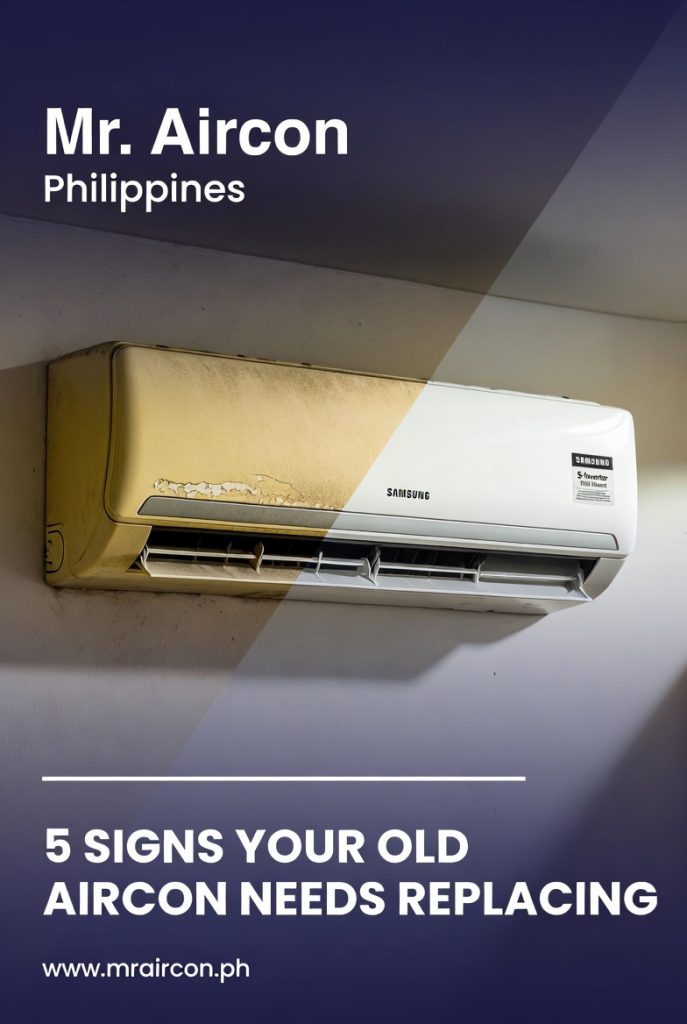
There is a particular kind of denial that Philippine households develop about old aircons. The unit still turns on. It makes cool-ish air. The remote still works. So every summer, the decision to replace it gets deferred for another year — until the unit fails completely in the middle of a 38°C afternoon in May, leaving the household scrambling for an emergency replacement at peak demand season when installation slots are full and prices are highest.
This article is about recognising the warning signs before that happens. If your aircon is showing two or more of the five signs below, the honest financial and comfort case for replacing it before this summer is stronger than the case for another year of repairs and high electricity bills.
Sign 1: It Takes 30 Minutes or More to Cool the Room
A well-functioning inverter aircon running at the correct HP for the room reaches the set temperature in 10 to 15 minutes under normal conditions. If your unit is still struggling to bring the room to a comfortable temperature after 30 minutes or more, the compressor is almost certainly degraded, the refrigerant charge is critically low, or the internal components are clogged beyond what cleaning can restore.
The problem with slow cooling is not just comfort — it is cost. Every extra minute of full-load operation adds to your electricity bill. A unit that used to cool your room in 12 minutes and now takes 35 minutes is running its compressor at maximum draw for almost three times as long before the room reaches temperature. Across a full summer of daily use, that difference is significant.
Sign 2: Your Electricity Bill Has Spiked Without a Change in Usage
This is one of the clearest financial signals that an aircon is failing. If your Meralco bill has increased noticeably — and your usage patterns have not changed — the aircon is the most likely culprit. Degraded compressors, dirty coils that force the motor to work harder, refrigerant loss, and failing capacitors all cause a unit to draw more electricity to deliver the same or less cooling output.
The comparison that matters here is not just the bill amount — it is the bill per degree of cooling. An old failing unit might be pulling 20–30% more electricity than a new inverter replacement would use to achieve the same room temperature. For a household running the aircon 8 hours daily through a four-month Philippine summer, that difference can represent thousands of pesos.
Sign 3: Grinding, Rattling, Clicking, or Hissing Sounds
Modern inverter aircons are designed to run near-silently during normal operation. The inverter compressor modulates smoothly, the fan motor runs quietly, and the only sound you should regularly hear is a gentle air movement. Any grinding, rattling, clicking, or hissing is a mechanical warning. Grinding typically indicates compressor bearing wear. Rattling suggests loose internal components or debris. Clicking can mean a failing relay or capacitor. Hissing usually indicates refrigerant leakage from the copper lines or unit body.
These sounds do not resolve with cleaning. They indicate internal mechanical degradation that typically costs more to repair correctly than the current market value of the unit warrants — particularly if the unit is more than 7–8 years old.
Sign 4: It Still Runs on R22 Refrigerant
R22 refrigerant was the global standard for residential air conditioners through most of the 1990s and 2000s. It has since been phased out internationally due to its significant ozone-depleting properties. In the Philippines, R22 units are still operating in many older households — but the refrigerant itself has become expensive and increasingly difficult to source as production has been restricted worldwide.
If your aircon technician has been refilling R22 on annual or semi-annual visits, your unit is running on borrowed time. The refrigerant cost alone will continue to increase, and a unit designed for R22 cannot simply be converted to the modern R32 standard. R32 — which all three replacement units recommended in this article use — has a global warming potential 68% lower than R410A and is more energy-efficient, meaning your new unit will cool better and cost less to run.
Sign 5: The Unit Is Over 10 Years Old and Breaks Down Regularly
The expected service life of a quality inverter aircon under normal Philippine use is 10 to 15 years with proper maintenance. A unit that has crossed the 10-year mark and is requiring service calls every 6 to 12 months has effectively reached the end of its reliable service life. Each repair extends the life of the unit by another short interval — but the cumulative repair cost over 2 to 3 years of continued breakdown-and-fix cycles almost always exceeds the cost of a new mid-range inverter replacement.
The break-even math is straightforward. A service call in the Philippines typically costs ₱1,500 to ₱5,000 depending on the issue. Two to three service calls per year over three years equals ₱9,000 to ₱45,000 in repair costs — with no energy savings, no warranty, and no guarantee the unit will survive the next summer. A new Samsung S-Inverter starting at ₱37,616 comes with a manufacturer warranty, lower energy costs from day one, and a projected service life of another 10 or more years with proper maintenance.
What to Replace It With
Three models stand out for Philippine households looking to replace an old unit this pre-summer season. The Daikin D Smart King Series (from ₱53,380) is the premium choice — Daikin’s Super PCB technology protects the compressor against the voltage fluctuations common on the Philippine power grid, making it particularly well-suited for homes in areas with unstable power supply. Available in 1HP to 3HP with R32 refrigerant.
The Samsung S-Inverter Wall Mount (from ₱37,616) delivers Digital Inverter Boost technology — fast initial cooling followed by efficient steady-state operation — at one of the most competitive price points for a genuine Samsung inverter unit. R32 refrigerant, available in 1HP to 2.5HP, with Samsung’s established local service network.
The Carrier Optima Split Inverter (from ₱34,675) is the Philippines’ most widely trusted aircon brand, locally manufactured, with the widest HP range of any unit on this list — 1HP through 3HP and beyond. For households that prioritize after-sales service certainty and parts availability over the long term, Carrier is the rational choice. R32 refrigerant throughout the range.
All three are in stock at Mr. Aircon Philippines with professional installation available in Metro Manila and Cebu.
📞 (02) 8477-1111 | 📱 0917-524-7266 | 📧 sales@mraircon.ph
🌐 www.mraircon.ph | aircon.ph | Open 24/7